Lacing Up Against the Dark: Why Oxford's Walkers Are Choosing Muddy Boots Over Low Moods This Winter
Let's be honest about November. The mornings are dark when the alarm goes off. The afternoons are dark by half past three. The pavements are wet, the sky is the colour of old dishwater, and the sofa is doing its very best impression of somewhere you should stay indefinitely. Anyone who tells you that getting outside in a British winter is easy is either lying or has a better relationship with Gore-Tex than the rest of us.
And yet. And yet.
Something keeps drawing Oxon Walkers 2030 members out through the door, week after week, even as the temperature drops and the daylight window narrows. For many of us, it stopped being just about the exercise a long time ago. It became, quietly and almost without us noticing, one of the most effective things we do for our mental health.
What the Research Actually Says
The link between physical activity and mental wellbeing isn't new — GPs have been recommending exercise as part of depression and anxiety management for years. But the specific benefits of outdoor walking, as opposed to gym-based exercise, are increasingly well-documented and genuinely compelling.
A 2019 study published in Proceedings of the National Academy of Sciences found that participants who walked in natural settings for 90 minutes showed significantly reduced activity in the area of the brain associated with repetitive negative thinking — the kind of rumination that tends to spiral during low periods. Gym walkers on a treadmill didn't show the same effect. The outdoor environment itself appears to matter.
More recently, researchers at the University of Exeter have been building on the concept of 'blue-green prescribing' — the idea that regular time spent near water and green spaces produces measurable improvements in mood, stress levels, and self-reported wellbeing. Oxford, sitting at the confluence of the Thames and Cherwell, surrounded by water meadows and green corridors, is extraordinarily well-placed to benefit from exactly this kind of environment.
Then there's the social dimension, which deserves its own paragraph entirely.
The Group Effect: More Than Just Company
Walking alone has its virtues — the solitude, the space to think, the freedom to stop and stare at a heron for as long as you like without feeling self-conscious. But walking with others does something different and, for many people, something more powerful.
Psychologists refer to 'social prescribing' as a growing approach within the NHS, where GPs actively refer patients to community activities — including walking groups — as a complement to clinical treatment. The reasoning is straightforward: loneliness and social isolation are significant risk factors for poor mental health, and group activities that build routine, accountability, and genuine connection address multiple factors at once.
For Oxon Walkers 2030 members, this plays out in very practical ways. When you've told someone you'll meet them at the Port Meadow car park at 9am, you're significantly more likely to actually be there than if you'd only promised yourself. The commitment shifts from internal to social, and that shift matters enormously when motivation is low.
Several of our members have spoken openly about how the group walks became a lifeline during particularly difficult periods. "I wasn't going to go," one member told us last January. "I hadn't slept properly in weeks and the last thing I wanted to do was talk to anyone. But I'd said I'd be there, so I went. Two hours later I felt like a different person. Not fixed — but genuinely better."
That's not an unusual story in our community.
Building a Winter Walking Habit: What Actually Works
Motivation is unreliable. Habit is more robust. Here are the strategies our members have found genuinely useful for keeping up winter walking when enthusiasm is in short supply:
Lower the bar deliberately. The walk doesn't have to be long or ambitious. A 25-minute loop around South Park in the rain still counts. The goal in winter isn't performance — it's consistency. Give yourself permission to do less, and you'll find yourself doing more.
Anchor it to something you already do. Several members walk to work part of the way, or take a lunchtime loop rather than scrolling at their desk. Tying the walk to an existing habit removes the decision-making friction that kills motivation.
Get the right kit — but don't overthink it. You don't need expensive gear to walk comfortably in a British winter, but a few key items make a real difference. A genuinely waterproof jacket (not just 'shower resistant') is worth the investment. Merino wool base layers are warm without bulk. A decent pair of waterproof trail shoes handles most Oxford-area paths without the need for full hiking boots. And a head torch — essential once the evenings close in — costs almost nothing but changes everything.
Use the light when it's there. Midday light in December and January, even on overcast days, still provides meaningful exposure to natural light, which plays a direct role in regulating mood and sleep cycles. A lunchtime walk, even a short one, is physiologically more beneficial in winter than the same walk at 4pm in the dark.
Join something with a regular schedule. This is where Oxon Walkers 2030 comes in, obviously — but the principle applies broadly. A walking group with a fixed weekly or fortnightly schedule provides the external structure that many people find difficult to create for themselves.
What Winter Walking Looks Like in Oxford
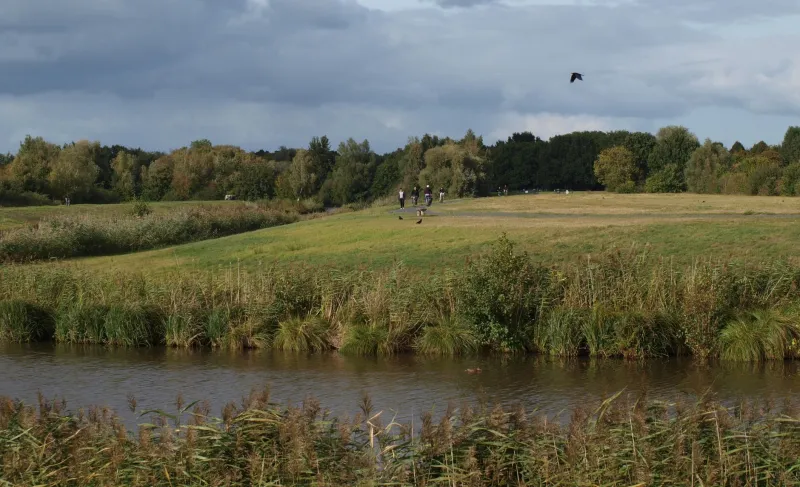
There's a particular kind of beauty to Oxford in winter that the summer crowds never see. The water meadows around Iffley hold frost until mid-morning on clear days. Port Meadow fills with Bewick's swans on cold snaps, arriving from Siberia to spend the winter on the flood water. The bare trees along the Cherwell expose the architecture of the city in ways that summer foliage hides entirely.
Winter walks here aren't a compromise or a consolation prize for the season you'd rather be having. They're their own thing, with their own rewards. The low-angle winter light on the Thames at Osney. The smell of woodsmoke from the narrowboats. The particular satisfaction of a hot drink in a warm pub after two hours in the cold.
You earn those moments in winter in a way you don't quite in summer. And that sense of having earned something — of having pushed against the inertia and won — turns out to be no small part of why it helps.
A Community That Shows Up
What makes Oxon Walkers 2030 more than just a walking club is the understanding, shared by most of our members, that we're not just here for the exercise. We're here for each other. The walks are the mechanism, but the connection is the point.
If you've been thinking about joining — or rejoining after a gap — winter is actually the best time to start. The group is smaller, the atmosphere is warmer (in every sense that matters), and the people who show up in January are exactly the kind of people you want to walk with.
The dark months don't have to be something you simply endure. With the right boots and the right company, they can be something you actually look forward to.
We'll be out there. Come and find us.